
Ridge Vent vs. Box Vent: Best Roof Ventilation for Indiana Homes
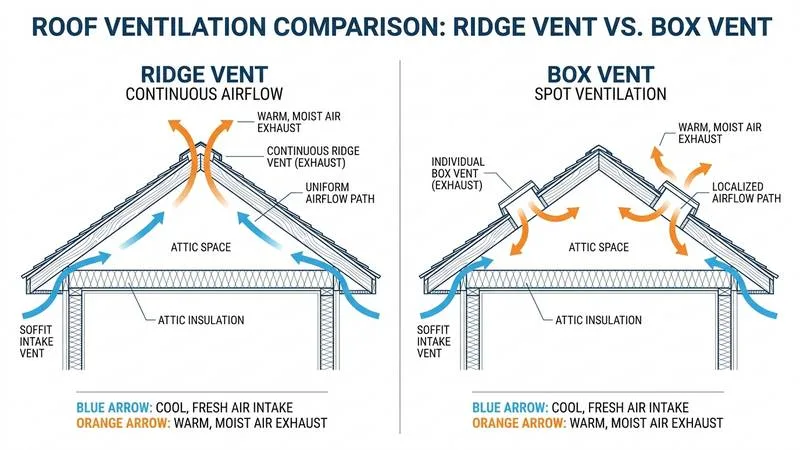
Ridge vents provide continuous airflow along the entire roof peak, while box vents exhaust air from individual openings on the roof slope. Ridge vents cost $7 to $15 per linear foot installed, and box vents run $65 to $190 per unit. Urban Shield Roofing recommends ridge vents for most Bloomington homes with continuous ridgelines and adequate soffit intake.
A poorly ventilated attic in Indiana pushes summer temperatures past 150°F, baking shingles from below and cutting years off their lifespan. The right exhaust vent for your roof design solves this completely. Here's how the two main options compare for Monroe County homes.
How Ridge Vents and Box Vents Move Air

Both systems rely on natural convection: hot air rises to the roof peak and exits through the exhaust vent, pulling cooler air in through soffit vents at the eaves. The difference is where and how that hot air escapes.
Ridge Vent Airflow
A ridge vent runs the full length of the roof peak, creating a continuous slot that pulls warm air from the entire attic evenly. Because the opening follows the highest point of the roof, hot air exits at its natural collection point. This design creates balanced, uniform ventilation across the full attic footprint without hot spots or dead zones.
Box Vent Airflow
Box vents are individual units placed at specific points on the roof slope, typically 2 to 3 feet below the ridge. Each unit serves a limited area, and coverage depends on having enough units spaced correctly. In larger attics, the gaps between box vents can create zones where heat stagnates because there's no nearby exhaust point.
Where Ridge Vents Perform Best

Ridge vents work best on roofs with a continuous, unbroken ridgeline and adequate soffit ventilation on both sides. Most ranch-style and Cape Cod homes in Bloomington meet both conditions. The continuous design means fewer potential leak points compared to multiple box vent penetrations, and the low profile blends into the roofline. During a residential roof replacement, adding a ridge vent is cost-effective because the ridge is already open. Ridge vents typically last 20 to 30 years, outpacing box vents by 5 to 10 years. For any Bloomington home planning a full residential roofing project, ridge vents should be the default consideration.
Where Box Vents Make More Sense

Box vents earn their place on complex roof designs where a continuous ridge isn't available. Hip roofs with short ridgelines, homes with multiple dormers, and roofs with interrupted peaks all limit how much ridge vent you can install. In these cases, box vents placed strategically provide adequate exhaust where ridge vents physically can't reach. They also cost less upfront for smaller roofs that only need two or three units. Some older Bloomington homes with original box vents in good condition don't need replacement until the next reroof. If your roof's design shows signs of ventilation problems, upgrading the vent type during replacement is worth evaluating.
Frequently Asked Questions
Can I mix ridge vents and box vents on the same roof?
Mixing exhaust vent types usually creates problems rather than solving them. A ridge vent can short-circuit airflow through nearby box vents, pulling air in through the box vents instead of out. Choose one exhaust system and size it properly for your attic's square footage. Urban Shield Roofing calculates the required net free area during every roof assessment.
How many box vents does a typical home need?
The general rule is one square foot of exhaust ventilation per 150 square feet of attic space (or 1:300 with a vapor barrier). For a 1,500-square-foot attic, that typically means 5 to 7 box vents depending on each unit's rated airflow. Placement matters as much as quantity, so spacing them evenly across the upper third of the roof is critical.
Does upgrading vents really extend shingle life?
Proper ventilation can add 3 to 5 years to your shingles in Indiana's climate by reducing attic temperatures and moisture buildup. An under-ventilated roof in Bloomington's summers bakes shingles from both sides, accelerating granule loss and mat deterioration. Balanced soffit-to-ridge airflow keeps attic temperatures within 10 to 15 degrees of outside air.
Pick the Ventilation System That Fits Your Home

For most Bloomington homes with a straight ridgeline and open soffits, a ridge vent delivers better, more consistent ventilation at a competitive long-term cost. For hip roofs, short ridges, or complex multi-section designs, properly spaced box vents provide the exhaust your attic needs. Either way, the exhaust system only works when paired with adequate soffit intake.
Contact Urban Shield Roofing at (812) 606-3636 for a free ventilation assessment during your next roof inspection.